
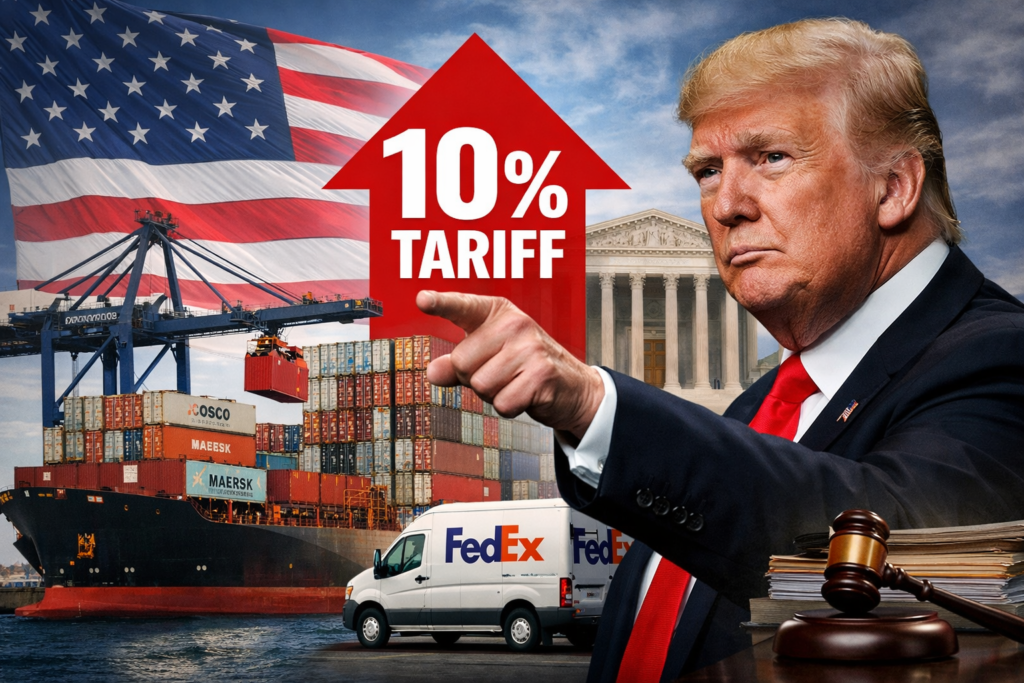
New global tariffs introduced by Donald Trump have taken effect at a rate of 10 percent, easing immediate pressure on British exporters after fears the levy could rise to 15 percent. UK business groups said the lower rate offers short-term relief but leaves companies facing fresh uncertainty.
The move followed a setback for the US president at the Supreme Court of the United States, which last Friday struck down the broad “liberation day” tariffs imposed the previous year. Shortly after the ruling, Trump announced a 10 percent global tariff, before warning in a post on Truth Social that the rate could increase to 15 percent.
A notice from US Customs confirmed that an additional 10 percent duty now applies to imports from all countries for 150 days starting Tuesday, unless exemptions apply. While Trump signaled a higher rate over the weekend, the 15 percent tariff has not yet been implemented and could still be introduced later.
Separately, FedEx filed a lawsuit against the US government on Monday, seeking reimbursement for tariffs it paid before the supreme court ruling. The Trump administration is imposing new duties under Section 122 of the Trade Act of 1974, without congressional approval, adding a 10 percent duty on top of existing most-favored nation tariffs.
William Benn, head of trade policy at the British Chambers of Commerce, said the lower rate was welcome, but highlighted how difficult the situation is for exporters. He warned that uncertainty over future tariff levels makes it difficult for businesses to plan pricing and margins for goods currently in production, which could ultimately hurt sales and economic growth.
Last week’s court decision found that a 1977 law intended for national emergencies did not give the Trump administration authority to impose many of its earlier tariffs. According to Atakan Bakiskan, a US economist at Berenberg, the new section 122 tariffs could also face legal challenges if the US trade deficit does not meet the legal threshold required to justify them.
Bakiskan added that it would be surprising if the administration abandoned its protectionist approach after the 150-day period ends. He said officials are likely to look for alternative legal routes to push tariffs closer to their preferred levels.
In Europe, the European Parliament halted work on ratifying last year’s US-EU trade deal following Trump’s announcement. However, EU Trade Commissioner Maros Sefcovic said on Tuesday that US officials had assured him the agreement would still be respected. He told lawmakers he had spoken repeatedly with U.S. Trade Representative Jameson Greer and Commerce Secretary Howard Lutnick, both of whom said they remained committed to the deal.
The FedEx case is the first major attempt by a large corporation to recover a share of an estimated $175bn in tariffs collected before the supreme court ruling. The lawsuit names US Customs and Border
Protection, its commissioner Rodney Scott, and the US government as defendants, and was filed in the US Court of International Trade. FedEx did not specify the amount sought but said it wants a full refund.
Prof Jennifer Hillman, a trade law expert at Georgetown University, said the ruling is likely to encourage further legal challenges, including against the new 10 percent levy. She said companies and industry groups may now feel more confident pushing back against other elements of Trump’s trade policy.